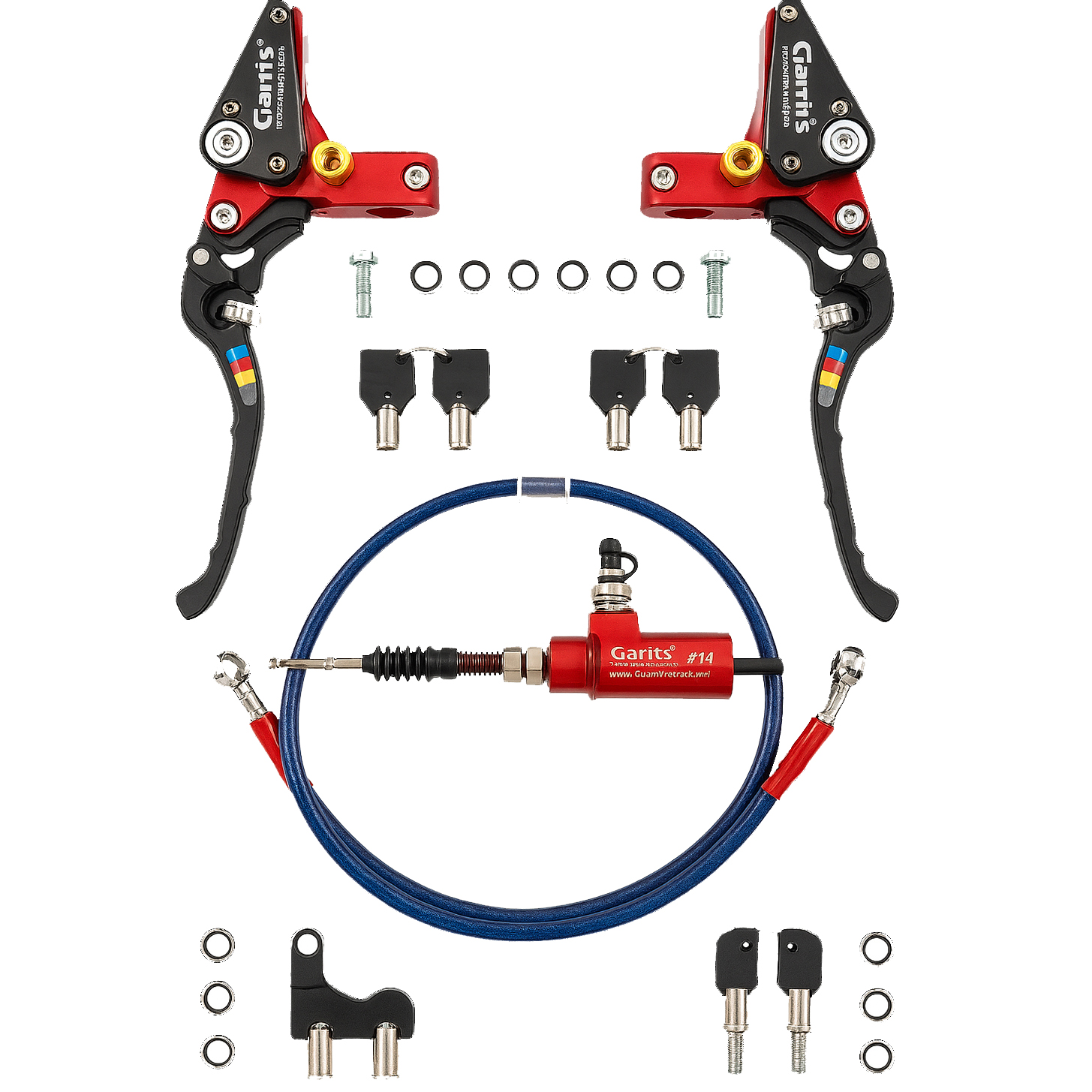
Motorcycle hydraulic clutch conversion kits replace traditional cable-operated clutch systems with more efficient hydraulic mechanisms. These upgrades reduce clutch effort, improve consistency and can significantly benefit riders with reduced hand strength or limited grip function.
Hydraulic conversion kits, such as the Magura Hymec range, are designed to replace traditional cable-operated clutch control systems with more efficient hydraulic mechanisms.
Compatibility
These upgrades are compatible with a wide range of on-road and off-road motorcycles, including popular brands such as Honda, Yamaha, Suzuki, Kawasaki, Triumph, BMW, KTM, Bombardier, Husqvarna, and AJP.
Note: This is not an exhaustive list; kits may also fit other marques. For more compatibility information, please refer to distributor websites.
For the latest compatibility details, it’s best to check with distributors, as some kits may well fit a number of other makes of motorcycle.
How Motorcycle Hydraulic Clutch Conversion Kits Work
- Cable-Operated Clutch
A cable-operated mechanical system is still commonly used to control motorcycle clutch systems. It consists of a cable connected to a lever on the handlebar at one end and a clutch actuator arm within the transmission housing at the other. When the rider pulls the clutch lever, the cable is drawn in, which in turn pulls the actuator arm. This action disengages the clutch plates, allowing the rider to change gears without transmitting power from the engine to the wheels.
Releasing the clutch lever gradually reduces the tension in the cable. This allows the actuator arm to return to its resting position, and springs within the clutch mechanism re-engage the clutch plates, restoring the connection between the engine and the wheels. While effective, this system can be inefficient, as some energy is lost due to friction and cable stretch before reaching the actuator arm.
- Hydraulic Clutch
A hydraulic clutch system operates differently. When the clutch lever is pulled, it activates a piston in the master cylinder, compressing hydraulic fluid. Because hydraulic fluid is resistant to compression, the pressure change is transmitted efficiently through the system. This pressure moves a second piston in the slave cylinder, which is connected to the clutch actuator arm by a short piece of cable. As the slave cylinder piston moves, it pulls on the clutch actuator arm, which in turn, disengages the clutch plates.
This process is explained by Pascal’s Law of Hydraulics, which states that, pressure applied to an enclosed, incompressible fluid is transmitted equally in all directions, allowing hydraulic systems to multiply force.*
Hydraulic systems are simply more efficient than cable systems and, as they require less physical effort to operate the clutch lever, this makes them particularly beneficial for individuals with reduced strength or function in their left wrist, hand, or fingers.
- The Key Benefits of Hydraulic Conversion
- Efficiency: Hydraulic clutches transmit force more efficiently, with minimal energy loss.
- Reduced Clutch Effort: Up to 20% less force required to operate the clutch lever,
making hydraulic systems preferable for users with limited hand strength.
- Less Fatigue: Less effort means less cumulative fatigue, which can be particularly noticeable on long journeys.
- Accessibility: Hydraulic kits are especially beneficial for riders with reduced grip strength or limited hand/arm function, making motorcycling more accessible for disabled riders.
- Consistent Performance: Hydraulic systems require less maintenance than cables, offering smoother and more reliable operation over time.
- Versatility: Some kits can be adapted for use with brake systems and some are available to suit different diameters of handlebars.
Installation
Fitting a hydraulic conversion kit is generally straightforward. However, if you are unsure, we recommend professional installation to ensure safety, comfort, and optimal performance.
Distributors and Further Information
- Venhill Engineering Ltd (Dorking, Surrey): Offers complete kits and individual components.
https://www.venhill.co.uk/controls-amp-handlebars/hydraulic-controls/clutch-conversion.html - Harley-Davidson: Produces its own hydraulic clutch conversion kit, available via UK dealerships and agents.
https://www.hogparts.co.uk/motorcycle-storehouse-hydraulic-clutch-conversion-kit-chrome-part-900568-p63222
NB. Other brands and distributors are also available.
* I make no apologies for including the brief explanation of Pascal’s Law of Hydraulics, I know many people aren’t aware of the science behind hydraulic systems and this was more-or-less how my dad explained it to me about fifty years ago as we worked together on my first set of hydraulic brakes. I’ve found physics (or ‘Natural Philosophy’ as it was known in more eloquent times) enthralling ever since, and I wasn’t about to pass up this chance to share a little of that fascination.
Empowering Disabled Riders
Hydraulic conversion kits help to make motorcycling accessible, comfortable and enjoyable, for many disabled people who suffer with reduced grip strength and/or reduced hand/arm function.
When it comes to motorcycling, a disability need not be a handicap!
Rick Hulse
NABD Chairman

Reviews
4.9 Star rating
The New NABD Online Membership Portal
The New NABD Online Membership Portal – What Members Need to Know We’re pleased to confirm that the new NABD online membership portal is now live and fully operational! This [...]





RIP Mike Hood (Captain Smurf) 17/06/1960 – 12/02/2026
RIP Mike Hood (Captain Smurf) 17/06/1960 – 12/02/2026 Despite my many years as a writer, I struggle to find the words to express the profound feelings of sadness and despondency [...]

The new Zeffy membership portal!
NABD has partnered with Zeffy to provide a secure, modern membership and donation portal. Learn how the new system works, why we chose it, and what it means for your membership.
The End Of An Era
The closure of leading UK trike builders signals a major shift in adapted trike manufacturing and wheelchair-accessible motorcycle design.

Roughley’s Bike Show 2025 – A Triumphant 25th Anniversary
Roughley’s Bike Show 2025 celebrated its 25th anniversary by raising £33,000 for charity, including a £2,500 donation to NABD.

30th and Final “You’ve Been Nabbed” Rally
A Landmark Year for the You’ve Been Nabbed Rally The You’ve Been Nabbed Rally 2023 marked a historic milestone as the 30th and final greenfield edition of this iconic NABD [...]

Media Coverage Reflects the Rally’s Legacy
National Press Recognition for a Landmark Event You’ve Been Nabbed Rally media coverage reached national level when Motorcycle News (MCN) featured the final rally in March 2023. MCN provided detailed [...]